Launch offer — valid today only

📄 Digital book in PDF · read it on your phone or print it

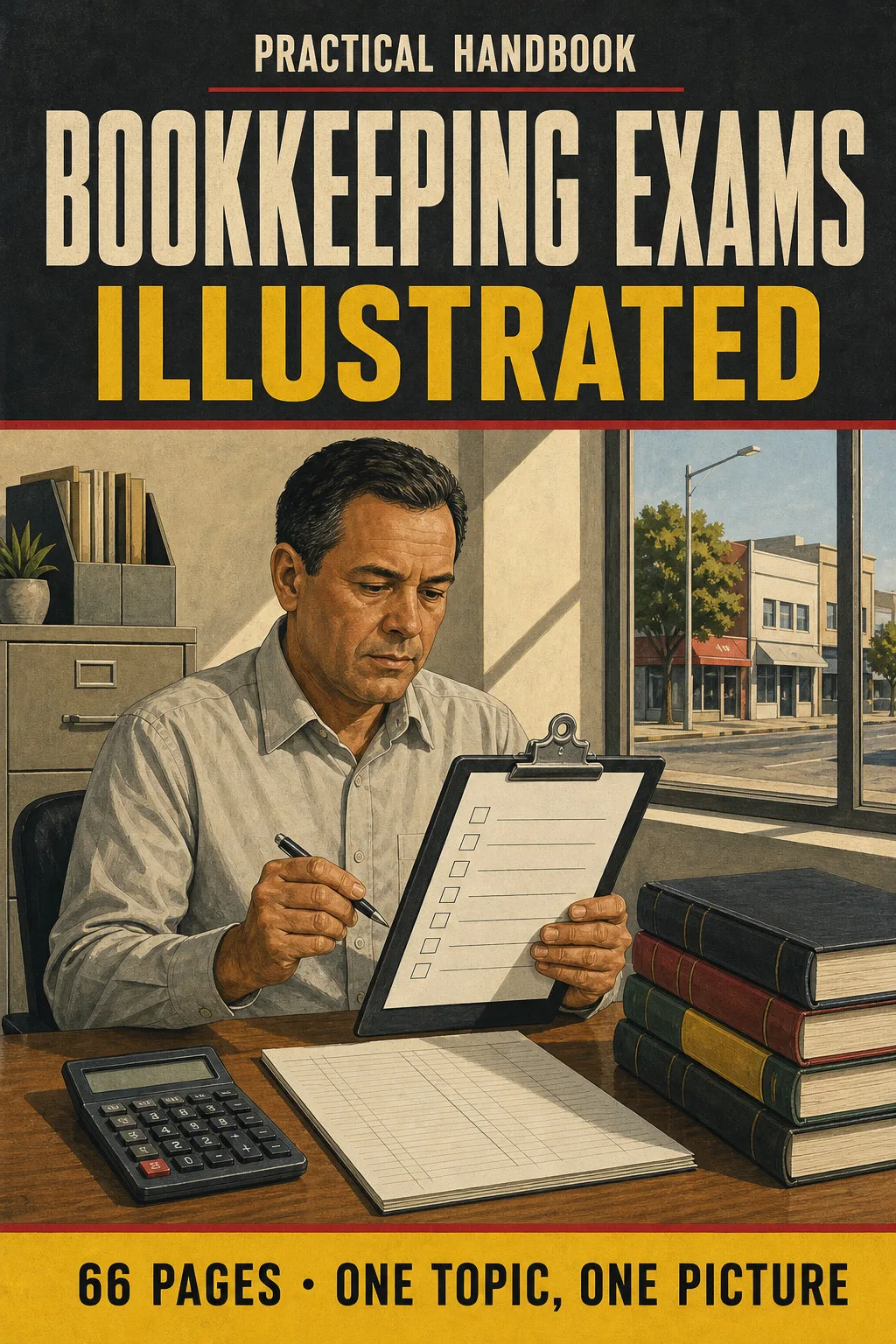
Bookkeeping Exams Illustrated: From Source Document to Trial Balance One Topic on Every Page

For South African bookkeeping students, including ICB and other NQF-registered courses. The accounting equation, double entry, the journals, the ledger, the trial balance, bank reconciliation, VAT at 15%, payroll and year-end: every topic has its own page, first the drawing, then what you need to remember. 66 illustrated pages.

START STUDYING THIS WAY

🔒 Secure checkout · PDF by email · 30-day guarantee

Every topic, its own pageEach rule drawn, with the explanation beside it
66 illustrated pages9 parts, from the accounting equation to the whole cycle on one page
Up-to-date sourcesThe current bookkeeping exam syllabus and SARS guidance on VAT and payroll
PDF by emailFormat

Look Inside the Book

Every page has one large drawing and a box with the steps and rules you need to know:

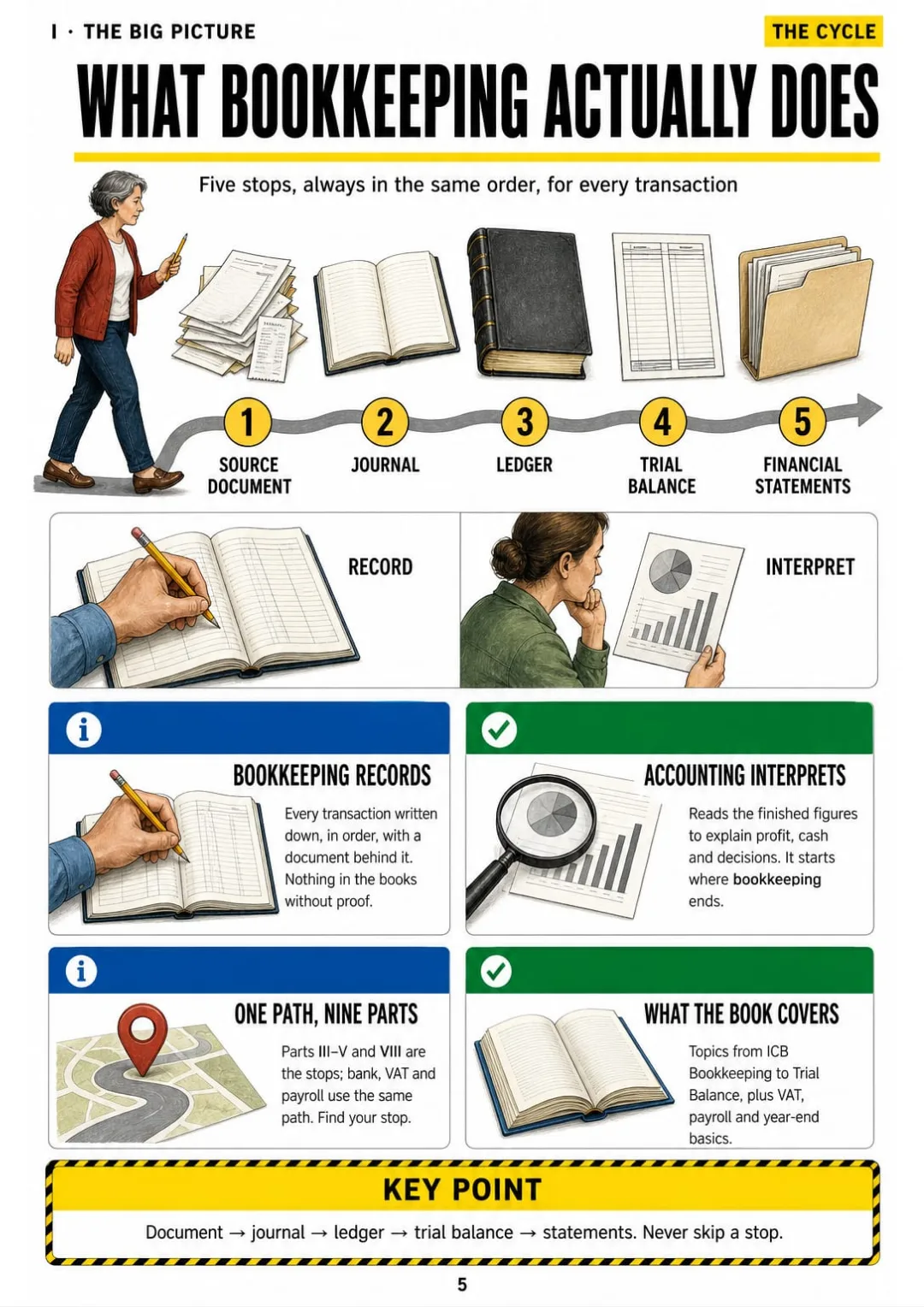
Source document → journal → ledger → trial balance → financial statements, drawn as one path.
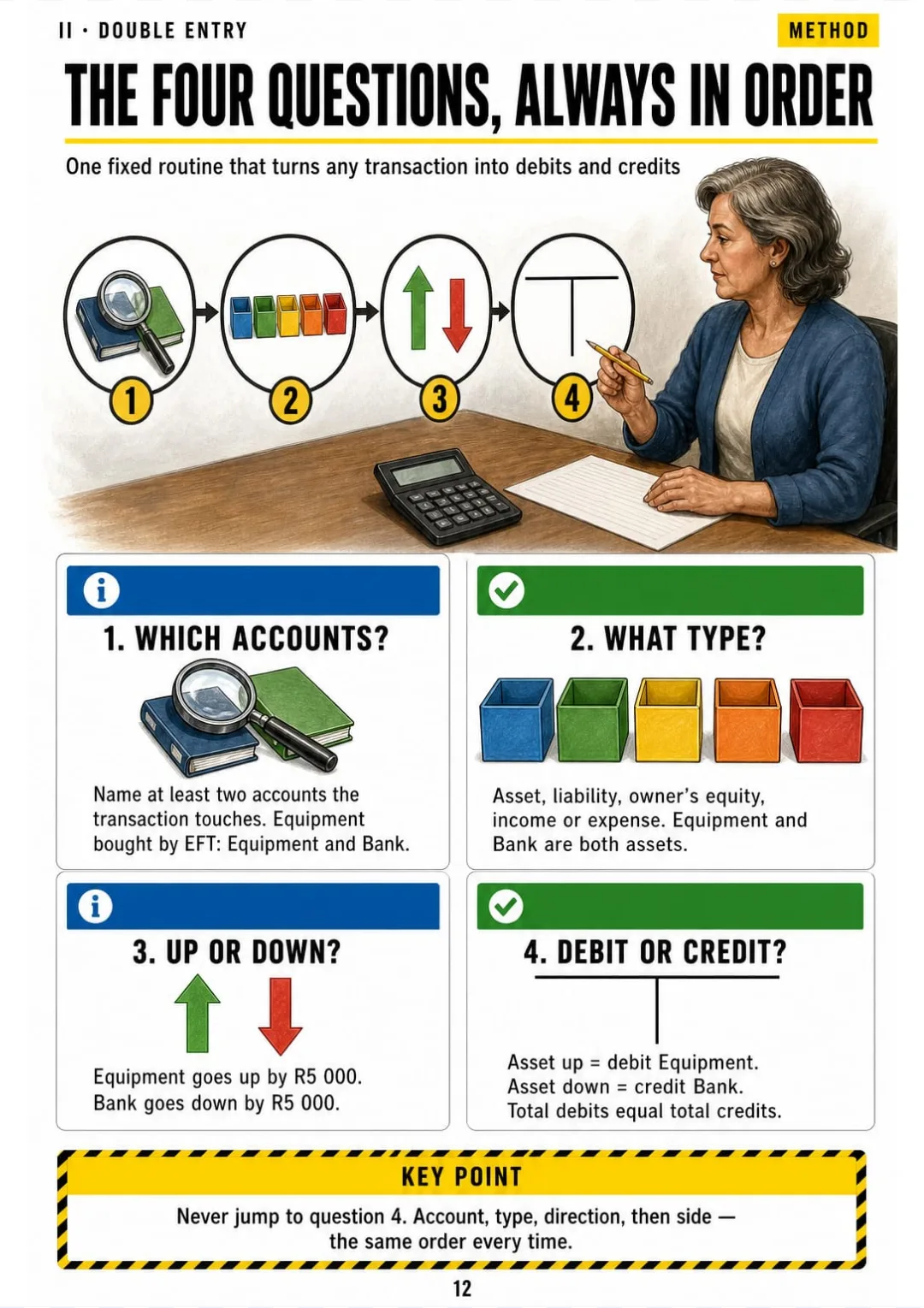
Which accounts → what type → up or down → debit or credit: the routine behind the whole book
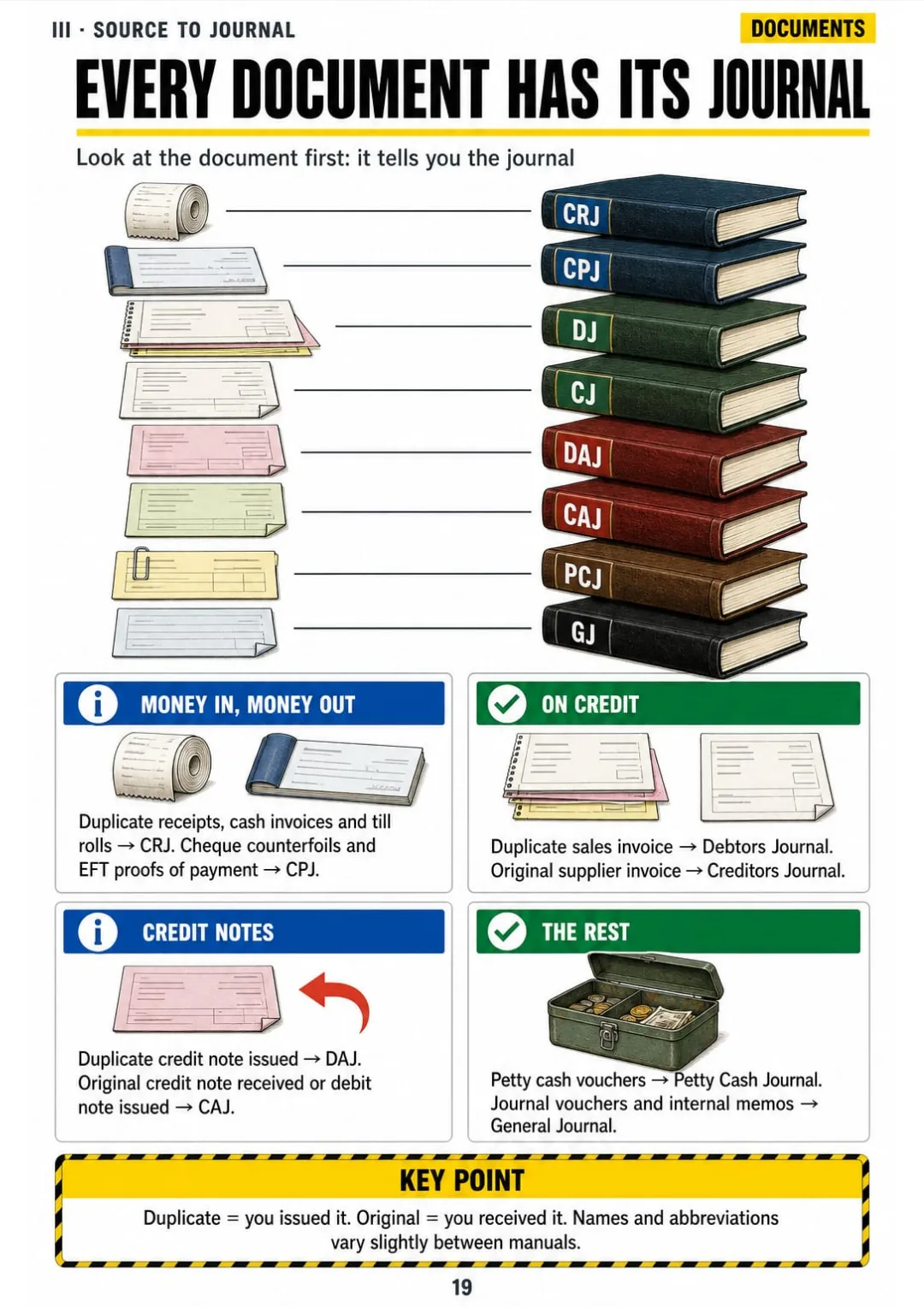
Eight source documents, eight journals: CRJ, CPJ, DJ, CJ, DAJ, CAJ, PCJ and GJ on one map.
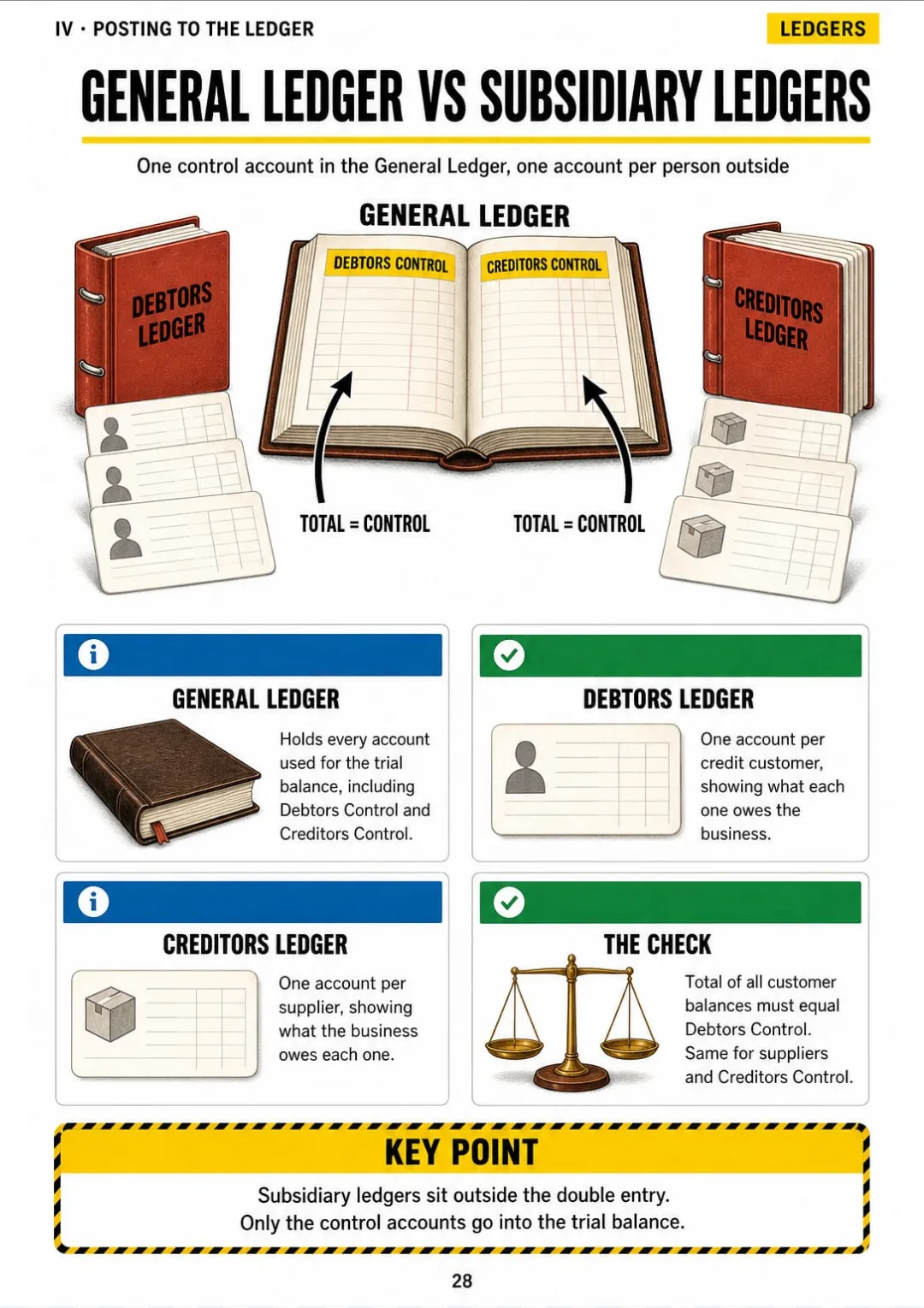
Debtors and Creditors Ledgers list each person; their total must equal the control account.
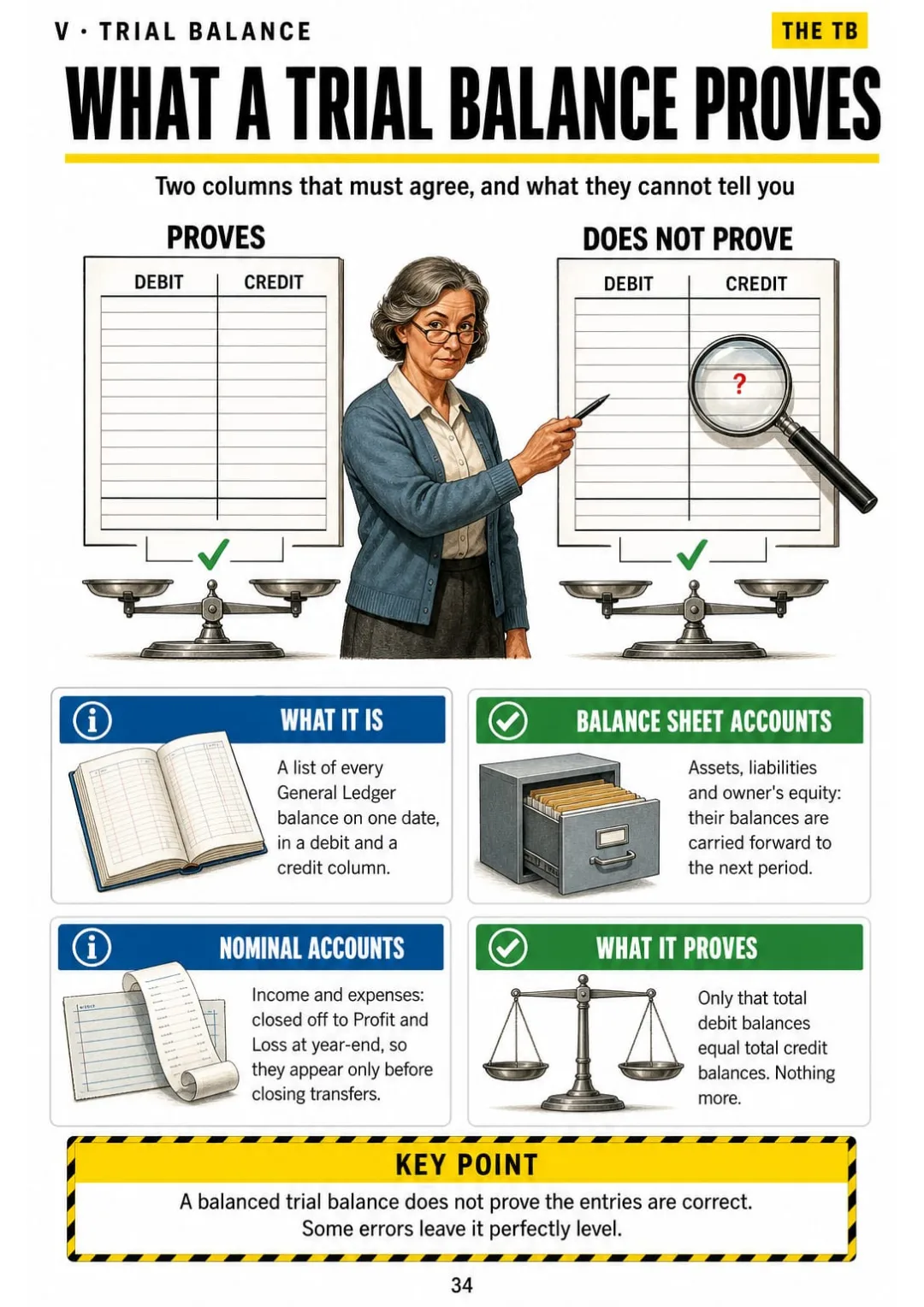
Debit total = credit total. That is all a trial balance proves.
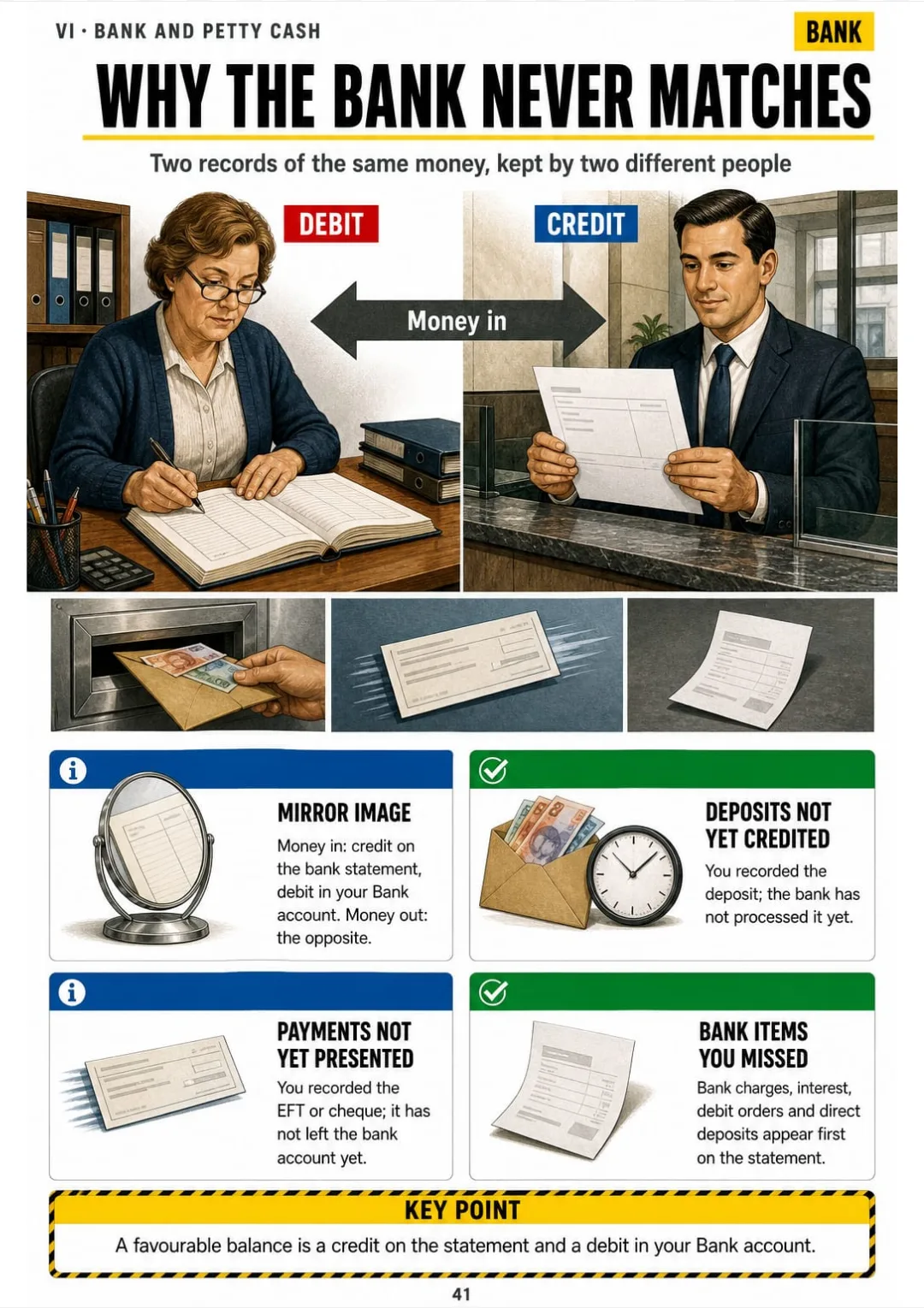
Statement credit = your debit; timing differences and unrecorded bank items explain why the balances differ.
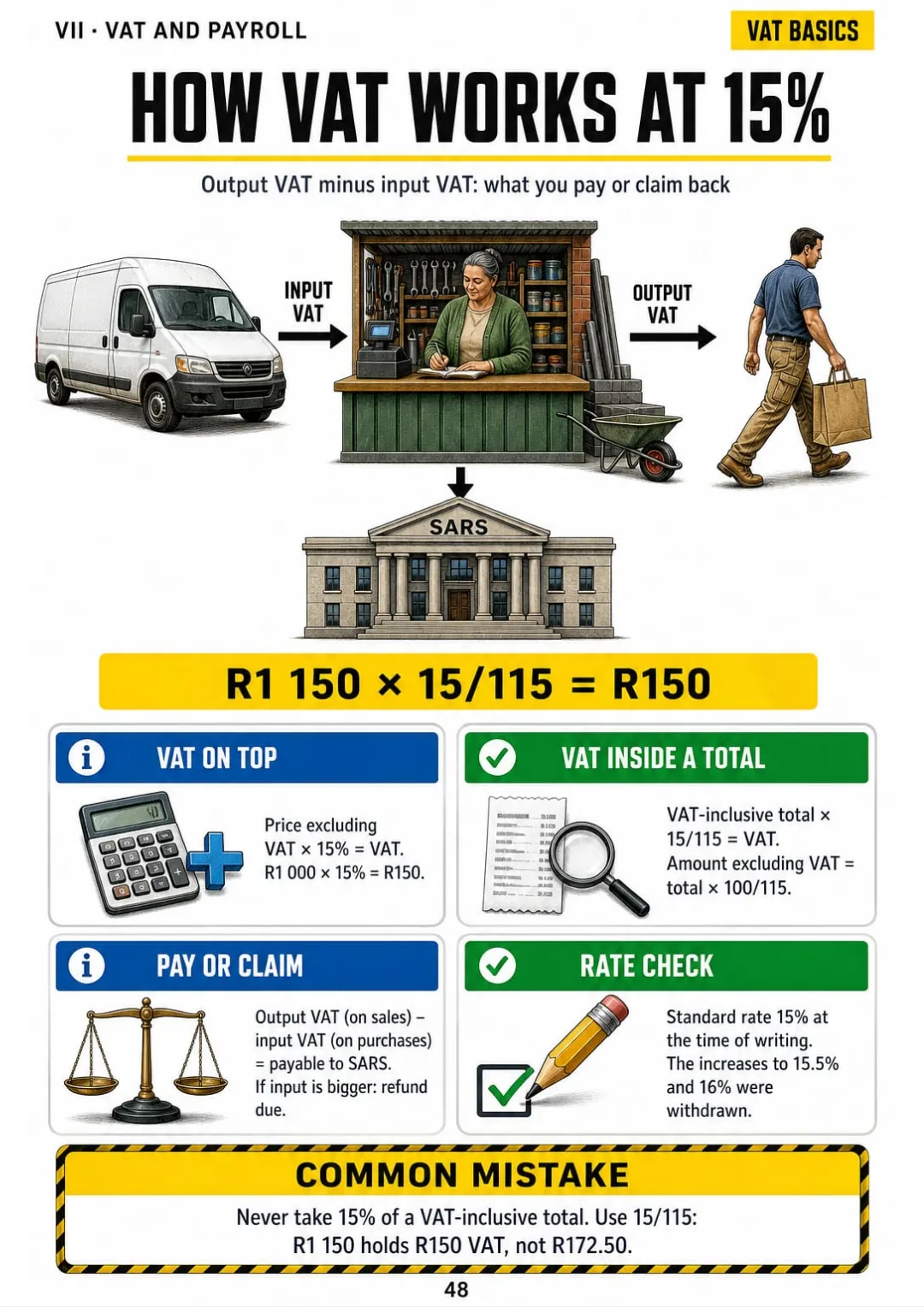
R1 150 including VAT × 15/115 = R150 VAT: the fraction every VAT question needs
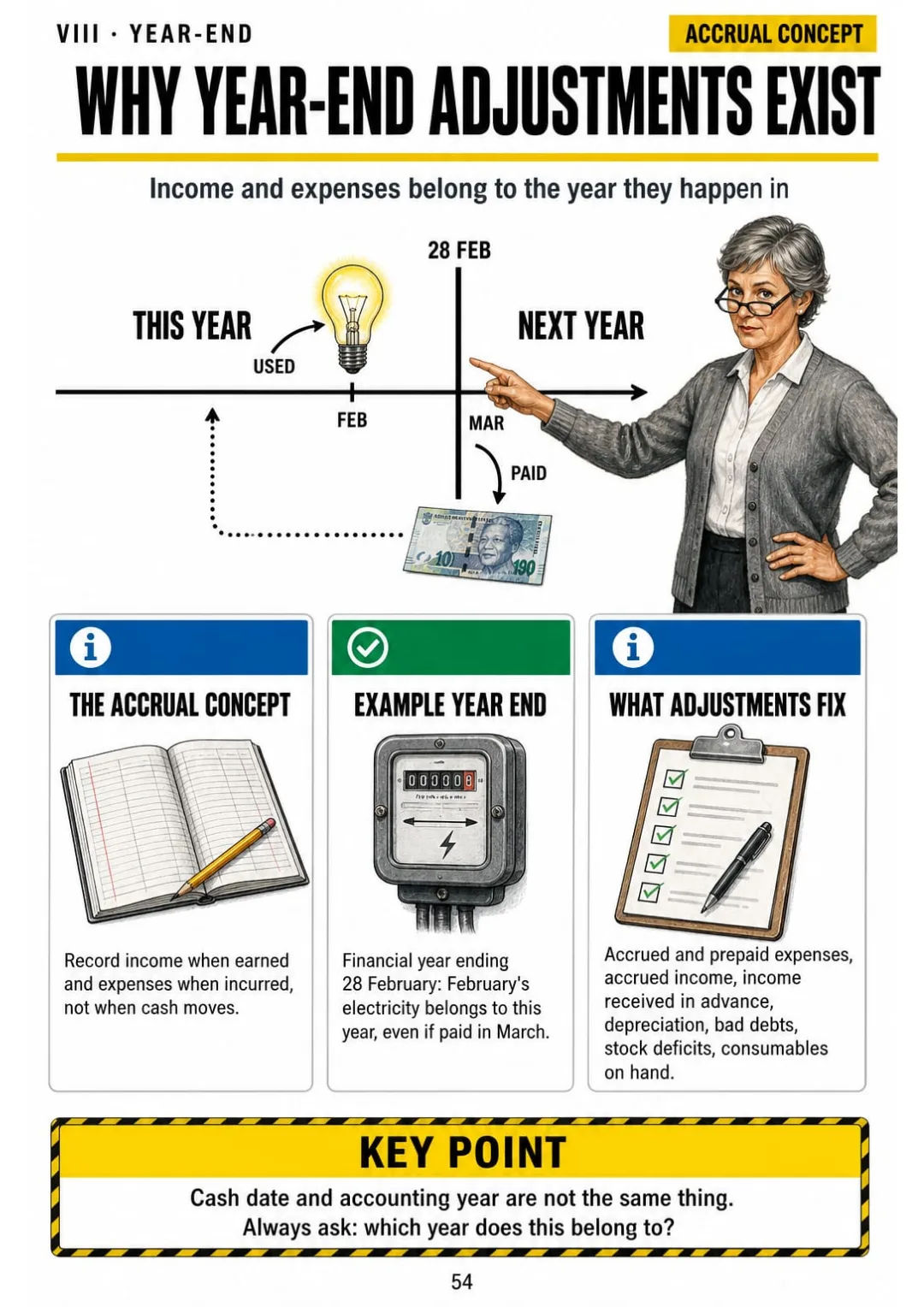
Accrual concept: February's expense belongs to February's year, even if paid in March.

Swipe to see more →

These are real pages from the book. The table of contents is the full one: 9 parts and 62 topics.

The Problem Isn't You. It's How It Was Explained to You.

You're holding the paperwork for goods sent back to a supplier, and the question asks which journal it goes into. CRJ, CPJ, DJ, CJ… the abbreviations start to blur into one.

Your manual gives each journal its own chapter, paragraph after paragraph. Nothing shows you all eight side by side, so every new document feels like a fresh guess.

Eight source documents, eight journals: CRJ, CPJ, DJ, CJ, DAJ, CAJ, PCJ and GJ on one map.

In the book, that question is one page: a map with eight source documents on one side and eight journals on the other, joined by arrows. The return to a supplier points straight to the Creditors Allowances Journal.

The same goes for the four questions behind every transaction, posting to the ledger, the trial balance, the bank reconciliation and VAT at 15%: each one has its own page.

You look at the document, find the journal on the map and write the entry. One page to check, not a whole chapter.

COMPARE FOR YOURSELF

The Same Topic, Two Ways to Study It

THIS
  • The manual: line after line
  • Debits and credits explained only in words
  • You walk into the exam with doubts
In analysing a transaction for the purposes of double-entry recording, the bookkeeper must first identify the accounts affected by the transaction, thereafter classify each account according to its nature as an asset, liability, owner's equity, income or expense item, subsequently determine whether the balance of each such account increases or decreases as a consequence of the transaction, and finally apply the appropriate debit or credit entry in accordance with the normal balance of that account type, bearing in mind that total debits must always equal total credits.
FOR THIS
  • The four questions in one drawing
  • The steps in a box, always in the same order
  • You see it and you get it
Which accounts → what type → up or down → debit or credit: the routine behind the whole book
CONTENTS

Take a Look at the 9 Parts and 62 Topics

The picture behind everything, double entry, the journals, the ledger, the trial balance and finding errors, bank and petty cash, VAT and payroll, year-end and exam revision: 66 pages, all illustrated.

IThe Picture Behind Everything · pp. 5-11
  1. What Bookkeeping Actually Does
  2. The Accounting Equation as a Scale
  3. Assets, Liabilities and Owner's Equity
  4. Income and Expenses Change Equity
  5. The Five Account Types
  6. The T-Account
  7. Debit or Credit: The One Rule
IIDouble Entry, Step by Step · pp. 12-18
  1. The Four Questions for Every Transaction
  2. Cash vs Credit Transactions
  3. Worked Example: Capital, Equipment and a Loan
  4. Worked Example: Income and Expenses
  5. Drawings Are Not an Expense
  6. Buying and Selling Trading Stock
  7. Returns, Discounts and Allowances
IIIFrom Source Document to Journal · pp. 19-27
  1. Source Documents and Where They Go
  2. Reading a Tax Invoice
  3. The Cash Receipts Journal
  4. The Cash Payments Journal
  5. The Debtors Journal
  6. The Creditors Journal
  7. Debtors and Creditors Allowances Journals
  8. The General Journal
  9. Totalling and Cross-Casting a Journal
IVPosting to the Ledger · pp. 28-33
  1. General Ledger vs Subsidiary Ledgers
  2. Posting from the Journals
  3. Folio References: The Audit Trail
  4. Balancing a T-Account
  5. Debtors Control and the Debtors List
  6. Creditors Control and the Creditors List
VThe Trial Balance and Finding Errors · pp. 34-40
  1. What a Trial Balance Proves
  2. Drawing Up a Trial Balance
  3. Errors the Trial Balance Will Not Show
  4. When the Trial Balance Does Not Balance
  5. The Suspense Account
  6. Correcting Errors in the General Journal
  7. Worked Case: Finding Three Errors
VIBank and Petty Cash · pp. 41-47
  1. Why the Bank Statement Never Matches
  2. Step 1: Tick and Compare
  3. Step 2: Update the Cash Book
  4. Step 3: The Bank Reconciliation Statement
  5. Carrying Items Forward to Next Month
  6. The Imprest Petty Cash System
  7. Petty Cash Errors and Controls
VIIVAT and Payroll in South Africa · pp. 48-53
  1. How VAT Works at 15%
  2. VAT in the Journals
  3. Standard, Zero-Rated and Exempt
  4. The VAT Return Cycle
  5. From Gross to Net Salary
  6. Employer Contributions and the Salaries Journal
VIIIYear-End and Financial Statements · pp. 54-61
  1. Why Year-End Adjustments Exist
  2. Accrued and Prepaid Expenses
  3. Accrued Income and Income Received in Advance
  4. Depreciation: Straight-Line and Diminishing Balance
  5. Bad Debts and the Allowance for Credit Losses
  6. Trading Stock Deficit and Consumables on Hand
  7. Closing Transfers and the Profit and Loss Account
  8. The Income Statement and the Balance Sheet
IXExam Revision and Common Mistakes · pp. 62-66
  1. The Same Order for Every Exam Question
  2. Ten Common Debit and Credit Mistakes
  3. Formulas and Ratios to Keep at Hand
  4. Month-End Checklist for the Office
  5. The Whole Cycle on One Page

One Page, One Topic, All Clear

Think of it this way:

It's month-end at the office, or question three of the exam, and the trial balance doesn't balance. The totals are out and you don't know where to start looking.

You open the book at When the Trial Balance Does Not Balance and the checks are drawn in order, from the totals back to the postings and the journals, with the suspense account on the next page.

Debit total = credit total. That is all a trial balance proves.

The same goes for the bank reconciliation, VAT at 15%, debtors control, depreciation and the closing transfers: each one on its own page, with its own drawing.

Bookkeeping Exams Illustrated is 66 illustrated pages in 9 parts, one topic per page, and it ends with an exam revision part: the same order for every question, the most common mistakes and the whole cycle on one page.

What you see drawn, you don't have to memorize.

What's Inside Bookkeeping Exams Illustrated:

Ipp. 5-11

The Picture Behind Everything

What bookkeeping does, the accounting equation as a scale, assets, liabilities and equity, the five account types, the T-account and the one debit-or-credit rule.

IIpp. 12-18

Double Entry, Step by Step

The four questions for every transaction, cash vs credit, worked examples with capital, loans, income and expenses, drawings, trading stock, returns and discounts.

IIIpp. 19-27

From Source Document to Journal

Source documents and where they go, reading a tax invoice, the cash, debtors, creditors and allowances journals, the general journal and cross-casting.

IVpp. 28-33

Posting to the Ledger

General ledger vs subsidiary ledgers, posting from the journals, folio references, balancing a T-account, and the debtors and creditors control accounts with their lists.

Vpp. 34-40

The Trial Balance and Finding Errors

What a trial balance proves, how to draw one up, the errors it won't show, what to do when it doesn't balance, the suspense account and correcting entries.

VIpp. 41-47

Bank and Petty Cash

Why the bank statement never matches, the three reconciliation steps, carrying items forward, and the imprest petty cash system with its controls.

VIIpp. 48-53

VAT and Payroll in South Africa

How VAT works at 15%, VAT in the journals, standard, zero-rated and exempt supplies, the VAT return cycle, and payroll from gross to net with employer contributions.

VIIIpp. 54-61

Year-End and Financial Statements

Why adjustments exist, accruals and prepayments, depreciation, bad debts, trading stock deficit, closing transfers, the income statement and the balance sheet.

IXpp. 62-66

Exam Revision and Common Mistakes

The same order for every exam question, ten common debit and credit mistakes, formulas and ratios, a month-end checklist and the whole cycle on one page.

At the end of the book: Ten common debit and credit mistakes, formulas and ratios to keep at hand, a month-end checklist and the whole cycle on one page.
Plus: 2 Free Books

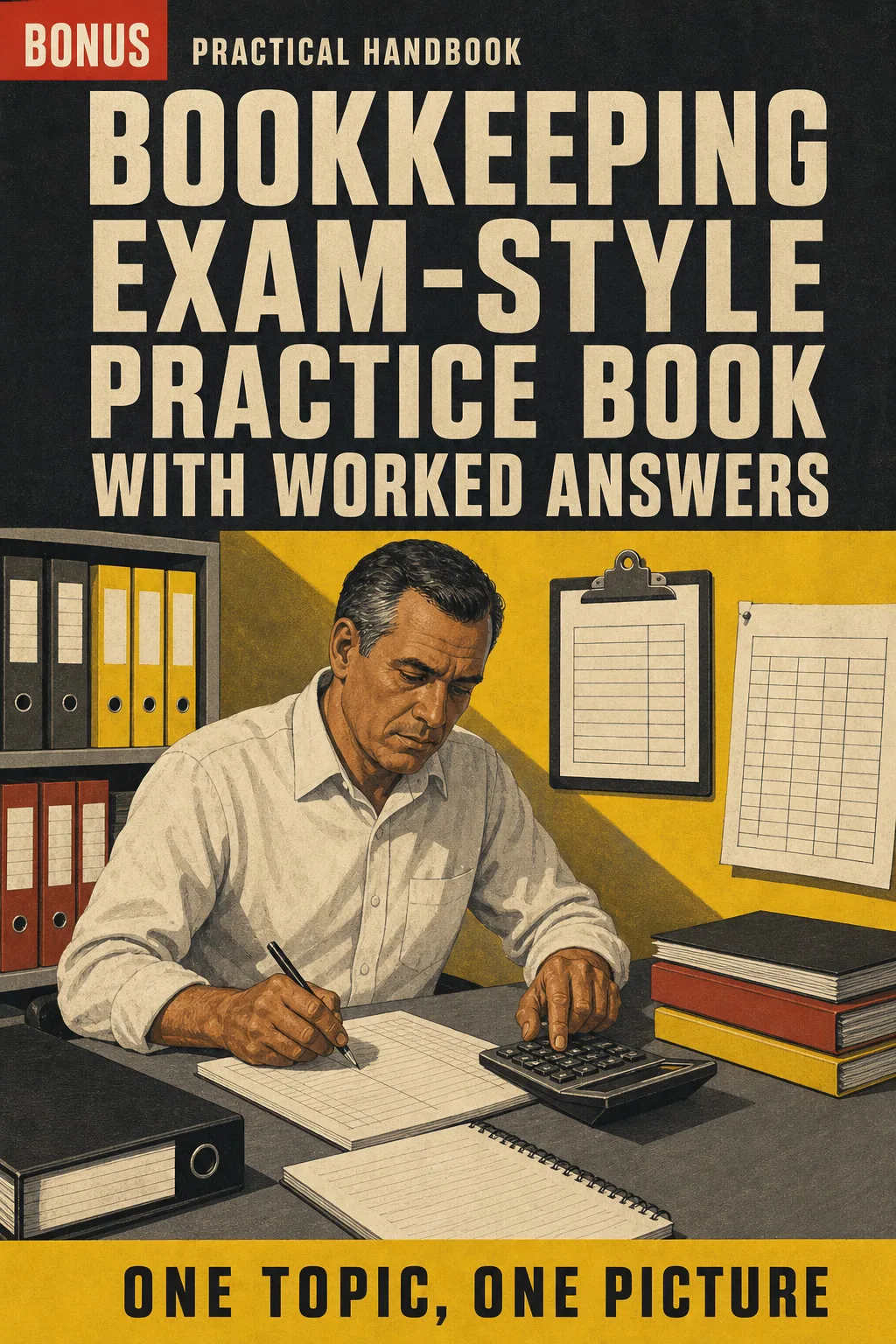
Bookkeeping Exam-Style Practice Book with Worked Answers

BONUS 1: «Bookkeeping Exam-Style Practice Book with Worked Answers»

Value on its own: US$ 17.90

Practise journals, posting, trial balances and bank reconciliations with exam-style questions, then check every step against the worked answer.

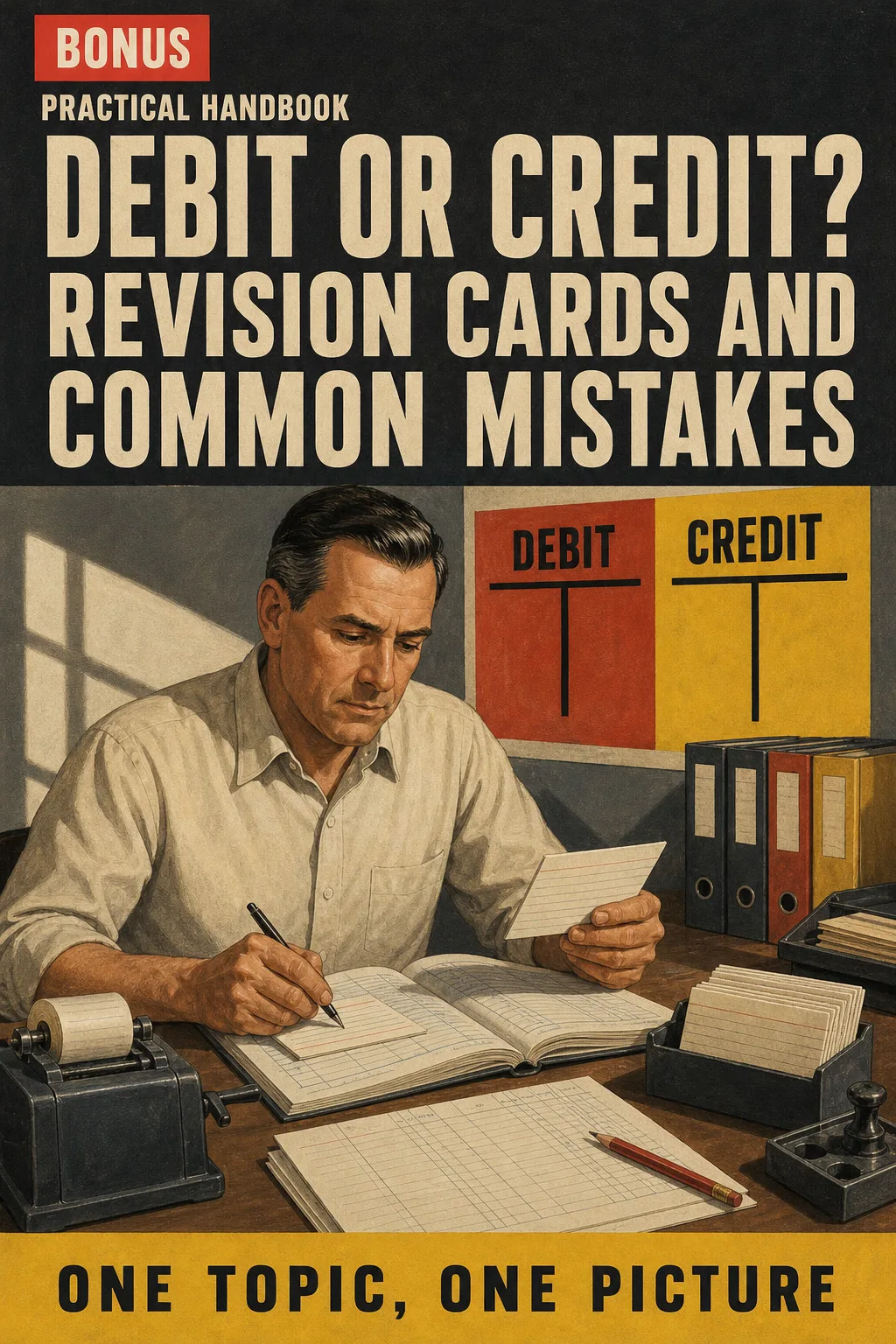
Debit or Credit? Revision Cards and Common Mistakes

BONUS 2: «Debit or Credit? Revision Cards and Common Mistakes»

Value on its own: US$ 14.90

One card per account type with its normal side, plus the mistakes made most often, so you can revise at a glance before the exam.

Bookkeeping Exams Illustrated with 2 Free Books

  • Bookkeeping Exams Illustrated: 66 illustrated pagesUS$ 63
  • BONUS 1: Bookkeeping Exam-Style Practice Book with Worked AnswersUS$ 17.90
  • BONUS 2: Debit or Credit? Revision Cards and Common MistakesUS$ 14.90
  • High-resolution PDF to printIncluded
Total value US$ 95.80
YOUR PRICE:
US$ 27
You save US$ 68.80
YES, I WANT BOOKKEEPING EXAMS ILLUSTRATED FOR US$ 27

📄 This is a digital PDF book sent to your email: nothing is printed or shipped.

Secure purchaseEncrypted payment30-day guarantee

PDF by email: We email you Bookkeeping Exams Illustrated as a PDF, together with the two free books. It's a single payment: no installments, no extra charges.

Who This Book Is For

You're studying bookkeeping by distance

You're studying bookkeeping by distance

Each topic has one page and one drawing, so even a short evening session covers something complete.

Your exam date is getting close

Your exam date is getting close

You revise the whole cycle in the same order every time, from source document to trial balance, and you know where each topic sits.

You already keep the books at work

You already keep the books at work

The bank reconciliation, petty cash and month-end steps are drawn, so you can print the page and keep it next to the keyboard.

Everything You Get Today

US$ 95.80US$ 27
YES, I WANT BOOKKEEPING EXAMS ILLUSTRATED FOR US$ 27

📄 This is a digital PDF book sent to your email: nothing is printed or shipped.

30DAYS
GUARANTEE

30-Day Guarantee

Try Bookkeeping Exams Illustrated for 30 days, bonus books included.

We refund everything if the file won't open, if the book isn't what you see here, if you were charged twice or if the email doesn't arrive. Just email us.

You pay once. No subscriptions.

Frequently Asked Questions

Is it for me if I already keep the books at a small business?

Yes. It starts from the accounting equation, then most pages deal with what you already do at work: journals, posting, the trial balance, bank reconciliation, VAT, payroll and year-end. It follows the topics of the South African bookkeeping qualifications from junior bookkeeper level. Open the index: every part lists its topics, so you can check them against your own syllabus before you study.

Where does the content come from?

From the current syllabus of the South African bookkeeping qualifications registered on the NQF, and from SARS guidance on VAT, PAYE, UIF and SDL. Rates and deadlines are marked so you can check them against the latest version.

Is it official material?

No. It's independent illustrated study material. It isn't issued, approved or endorsed by any exam body or authority.

Does it replace my course?

No. It doesn't give you a certificate or credits: those come only from your course and the exam. What it adds to your manual is the picture: each topic on one page, drawn, with the steps in a box, so you revise faster and see how journals, ledger and trial balance connect.

Are the practice questions the ones from the exam?

No. They are exam-style questions written for this book, with worked answers. They are not official exam questions.

When and how does it arrive?

The book and the 2 free books arrive as a PDF by email, at the address you enter at checkout.

Do I have to pay every month?

No. It's a one-off payment. There's no subscription.

Can I have it on paper?

Yes. The PDF is made to print, at home or at a print shop, in full or just the pages you need.

How does the refund work?

You have 30 days. We refund everything if the file won't open, if the book isn't what you see on this page, if you were charged twice or if the email doesn't arrive: just email us.

Before You Close This Page

No more rereading without anything sticking.

Which journal a document goes into, you see it drawn and that's it.

You walk into the exam knowing where everything is.

Drawings make studying faster.

The book is right below.

One-time payment: US$ 27 · Guarantee: 30 days · PDF by email

YES, I WANT BOOKKEEPING EXAMS ILLUSTRATED FOR US$ 27

📄 This is a digital PDF book sent to your email: nothing is printed or shipped.